Three good first sergers
All three trim and wrap a raw edge in one pass, have differential feed for stretchy and slippery fabric, and sew up to 1,300 stitches a minute. They differ in thread setups, how rolled hems are set and how much help you get threading.
Brother 1034D
The 1034D keeps the first serger simple. Brother color-codes the upper thread guides and adds a lower looper threading system, and it comes with standard, gathering and blind stitch feet.
- Best for: finishing seams on garments, knit seams and narrow or rolled hems
- Why it fits: 3- and 4-thread overlock plus narrow hem, rolled hem and ribbon lock stitches, at 13.45 pounds
- Skip if: you want 2-thread stitches, which both Singer picks have
Singer S0100
The S0100 adds 2-thread stitches and sets a rolled hem with a lever, with no stitch plate to change. Singer pairs color-coded thread paths with lay-in tension dials, so the thread slips into each dial.
- Best for: napkins and scarves with rolled hems, knit tops and light edge finishing
- Why it fits: 2-, 3- and 4-thread stitches, a free arm for cuffs and sleeves, 13.5 pounds
- Skip if: you will only sew 3- and 4-thread seams, which the 1034D covers too
Singer HD0500S
The HD0500S lights the lower looper threading path, the step many beginners find hardest. Its tension dials and thread paths are color-coded, and a lever moves it to rolled hems without changing the stitch plate.
- Best for: beginners who want help seeing the looper path
- Why it fits: 2-, 3- and 4-thread stitches, presser foot pressure you can set for heavy or fine fabric, and a free arm
- Skip if: weight matters: at 15.9 pounds it is the heaviest of the three
Compare the three sergers
| Best first serger Brother 1034D See at Amazon | Easiest rolled hems Singer S0100 See at Amazon | Lit looper threading Singer HD0500S See at Amazon | |
|---|---|---|---|
| Thread setups | 3 or 4 threads | 2, 3 or 4 threads | 2, 3 or 4 threads |
| Built-in stitches | 5 named stitches | 6 | 6 |
| Rolled hem | Yes | Yes, with a lever | Yes, with a lever |
| Threading help | Color-coded guides and lower looper system | Color-coded paths and lay-in tension dials | Lower looper light, color-coded paths and dials |
| Free arm | Not yet verified | Yes | Yes |
| Top speed | 1,300 a minute | 1,300 a minute | 1,300 a minute |
| Machine weight | 13.45 lb | 13.5 lb | 15.9 lb |
| Warranty | 1/5/25-year limited | 90-day/2-year/25-year | Up to 25 years |
- Best first serger
Brother 1034D
- Thread setups
- 3 or 4 threads
- Built-in stitches
- 5 named stitches
- Rolled hem
- Yes
- Threading help
- Color-coded guides and lower looper system
- Free arm
- Not yet verified
- Top speed
- 1,300 a minute
- Machine weight
- 13.45 lb
- Warranty
- 1/5/25-year limited
- Easiest rolled hems
Singer S0100
- Thread setups
- 2, 3 or 4 threads
- Built-in stitches
- 6
- Rolled hem
- Yes, with a lever
- Threading help
- Color-coded paths and lay-in tension dials
- Free arm
- Yes
- Top speed
- 1,300 a minute
- Machine weight
- 13.5 lb
- Warranty
- 90-day/2-year/25-year
- Lit looper threading
Singer HD0500S
- Thread setups
- 2, 3 or 4 threads
- Built-in stitches
- 6
- Rolled hem
- Yes, with a lever
- Threading help
- Lower looper light, color-coded paths and dials
- Free arm
- Yes
- Top speed
- 1,300 a minute
- Machine weight
- 15.9 lb
- Warranty
- Up to 25 years
Do you need a serger and a sewing machine?
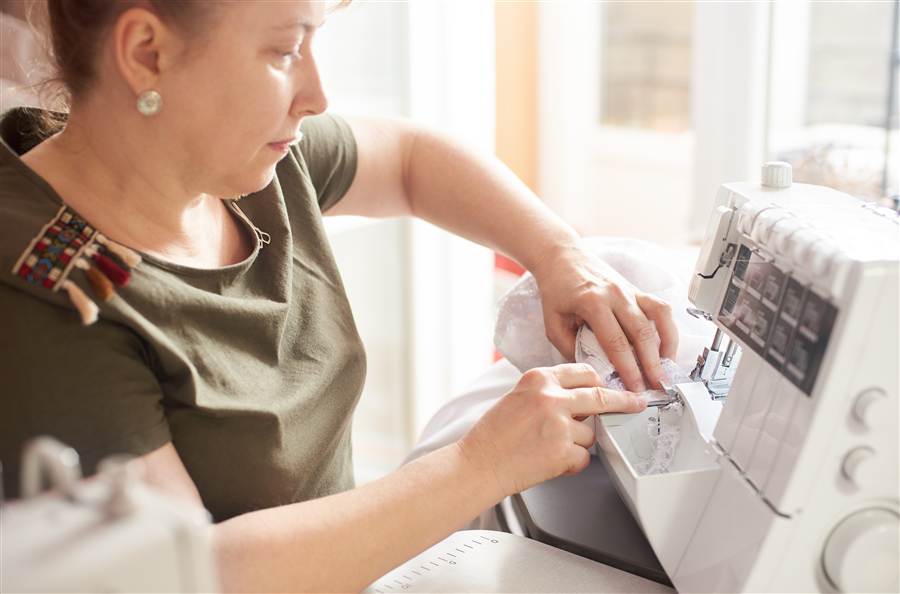
Most beginners need a sewing machine first. A serger works beside it: it trims, sews and wraps an edge in one pass, which makes knit seams and clean seam finishes fast.
It does not replace a sewing machine. A basic serger does not sew zippers, buttonholes or topstitching away from an edge. Our sewing machine vs serger guide compares the two jobs side by side.
- A serger does: seam finishes, knit seams, rolled hems, gathering with the right foot
- A sewing machine does: zippers, buttonholes, topstitching, quilting and most repairs
Threading is the part to learn
A serger has four thread paths on these models: two needles and two loopers. Once it is threaded, sewing feels much like a sewing machine. These habits make threading easier:
- Thread in the exact order your manual gives. On many sergers that starts with the loopers.
- Follow the colored marks on the machine. All three picks color-code their thread paths.
- Use the tweezers that come with each of these machines to reach the lower looper.
- Sew a few inches on a scrap before every project to check the stitch.
Good first serger projects
Start flat and simpleHow We Picked
We compared Brother's and Singer's product pages and manuals. Each pick had to be a current home serger with differential feed, sold new and in stock as the exact model.
Beginner serger questions
Is a serger hard for a beginner?
Threading takes the most practice, because there are more thread paths than on a sewing machine. Once it is threaded, the pedal and guiding the fabric work much as they do on a sewing machine.
What is the difference between 3-thread and 4-thread?
A 4-thread overlock uses two needles, which adds a second line of stitching for a stronger seam. A 3-thread overlock uses one needle and makes a lighter edge finish.
What does differential feed do?
It changes how fast the front and back feed dogs move. That lets you sew stretchy fabric without wavy seams and sheer fabric without puckers, or gather fabric on purpose.
Can a serger replace my sewing machine?
No. A basic serger cannot sew zippers, buttonholes or topstitching. Most sewists use both. See sewing machine vs serger.
Can a serger hem T-shirts like store-bought ones?
Not quite. The two-line stretch hem on T-shirts comes from a coverstitch machine. See serger vs coverstitch.
Specifications and manuals
Check the manufacturer’s model details and included accessories:
Our recommendations use published information, not hands-on testing. How we evaluate machines. Report a correction.